
Measure the route, not the sofa
The measurement that matters is the sofa's diagonal height — corner to corner across the end — because that is what has to clear a doorway when it is turned on its side. Measuring width against door width is the classic mistake and it is why sofas get stuck.
Then walk the whole route rather than the first obstacle. In a tenement the tight point is usually not your flat door: it is the half-landing turn, or the close door at the bottom which is often narrower than anything inside. In a house it is frequently the hall-to-porch turn.
Two easy wins before anyone panics. Doors come off their hinges in about two minutes with a screwdriver and buy you a couple of inches. And most sofa feet and legs unscrew, which can be the difference on a tight turn.
- Measure diagonal height, not width
- Check the tightest doorway
- Check the stair turn and half-landing
- Look at the close door, not just the flat door
- Remove the door from its hinges if needed
- Feet and legs usually unscrew
When it has to come apart
Plenty of sofas were assembled in the room or brought in through a window years ago, and some genuinely will not come out whole. Modular and corner sofas usually separate — look underneath for clips or bolts joining the sections, which is how they were carried in.
For a solid frame that will not fit, the options are a window lift or dismantling. Dismantling is destructive and it is the end of the sofa, so it is a last resort if the piece has any life left — but if it is going for disposal anyway, breaking it down in the room is faster, safer and cheaper than a hoist.
Our crews do this routinely and clean up after. It is not an extra charge; it is part of the job on a Glasgow tenement flat.
Before it goes: is it actually finished?
A sofa in genuinely good condition is worth re-homing rather than recycling. Charity shops and reuse organisations will take upholstered furniture — but only if it still carries its fire safety label, which is the one thing that decides it.
That label is the small tag sewn into the frame or under a cushion showing compliance with the furniture fire safety regulations. Without it, no charity, reuse scheme or second-hand dealer can legally take upholstered furniture, and none will. If the label has gone, the sofa's only route is disposal, however good it looks.
It is worth checking before you make phone calls. Our guide to fire safety regulations for furniture in Glasgow explains the detail.
Third floor, no lift, awkward turn?
Normal Tuesday. We take it apart if we have to and carry it down — the carry is in the price.
Your three routes
Glasgow City Council's bulky uplift is chargeable and booked in advance, and it requires the sofa to be at the agreed collection point. That is fine for a house with a driveway. In a tenement it means somebody still has to get it down the stair, which is the part most people are stuck on.
A recycling centre is free for residents with proof of address, but you need a vehicle it fits in — and if that vehicle is a hired van, resident van rules and time windows apply, with Polmadie taking no vans at all.
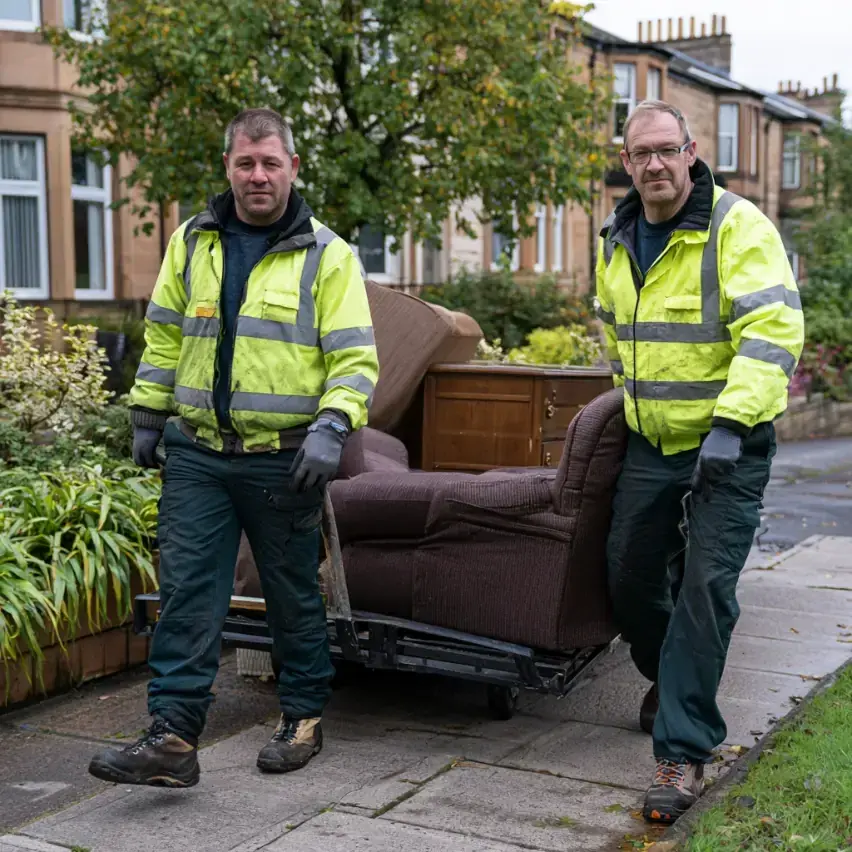
A collection is the third route. We come to the flat, do the carrying, and take it the same or next day. The carry is included in the price rather than added afterwards, which for a second-floor tenement is most of the work.
The one thing not to do
Do not put it beside the bins in a back court or on the pavement to be dealt with later. Once it is there it is not presented for the normal round — it is waste dumped on communal or public ground, which is fly-tipping.
In a tenement the bill for removing it lands on the factor or the owners, which means your neighbours. On a public pavement it is the council's, and it is an offence with a fixed penalty attached. Either way it costs more than a collection would have.
It also sits there. A sofa in a back court in Glasgow attracts more of the same within a fortnight, which is how a bin store becomes a dumping ground. Our flat residents' guide covers the tenement side properly.
What it costs and what happens to it
A single sofa is a quarter load at £160 + VAT, and that includes the carrying, whatever floor it is on. Two or three pieces of furniture together are usually still a quarter load, so it is worth doing it in one go rather than piece by piece.
What happens next depends on condition. Anything genuinely reusable with its fire label intact is separated for reuse. Upholstered seating made before 2019 is kept separate from the rest of the load and sent for high-temperature disposal, because it contains old fire-retardant chemicals and is banned from landfill in Scotland. Everything else in a furniture load is sorted normally, with over 80% diverted from landfill.
You get a duty of care (your legal responsibility for waste you produce) transfer note under our SEPA registration (WCR/R/3002381) either way. That is furniture removal.
