
Inert waste, and why the pricing changes
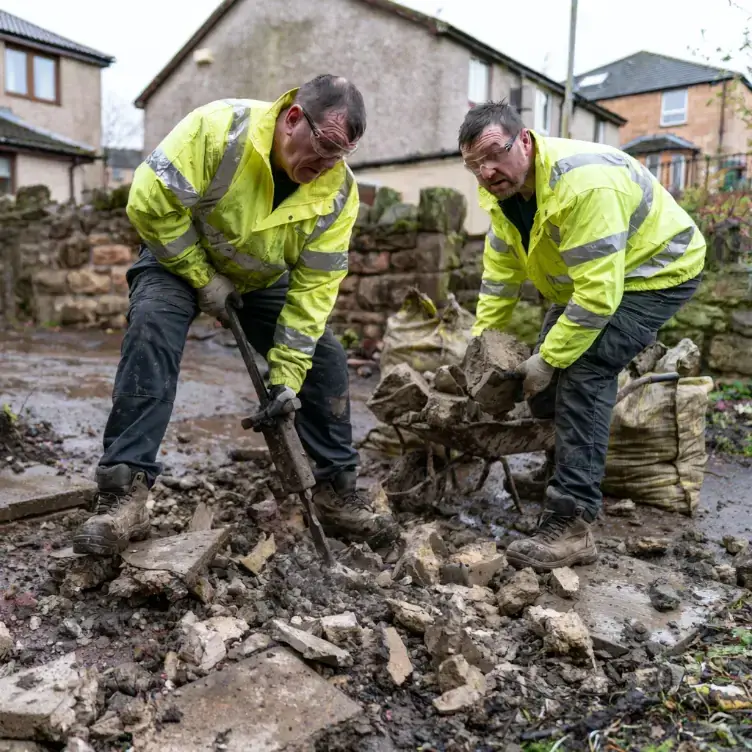
Bricks, tiles, concrete, blocks, hardcore, stone and soil are inert waste. They do not rot, they do not leach and they are not hazardous — but they are dense, and a lorry reaches its legal weight limit long before it looks full.
That is why inert material is priced by weight rather than by volume. Ours is £149 per tonne, and as a rule of thumb 25 rubble sacks is about a tonne. A bathroom's worth of tiles and old ceramic is usually well under that.
The practical consequence is worth understanding: mixing rubble into a general load is the expensive way to do it. Separated into a corner, even roughly, it is charged by weight; jumbled through a general load it takes up volume you pay for and can trigger the £250 heavy mixed load supplement.
- Inert: brick, tile, concrete, hardcore
- Also soil, stone and ceramic
- Priced by weight, not volume
- £149 per tonne with us
- 25 rubble sacks ≈ 1 tonne
- Keep it separate from general waste
Tiles specifically
Ceramic and porcelain wall and floor tiles are inert and go with rubble. What they are not is glass — vitreous ceramic will not melt with bottle glass and contaminates the batch, so tiles never go in glass recycling however similar they look.
Old tiles usually come off with a layer of adhesive and sometimes plasterboard attached. Adhesive is fine in with the rubble; plasterboard backing is not, and needs separating because gypsum (the mineral inside plasterboard) has to be kept out of general and inert loads. That is covered in our plasterboard guide.
One caution for older properties: vinyl floor tiles from before 2000, and the black bitumen adhesive under them, can contain asbestos. If you are lifting old vinyl tiles in a pre-2000 building, that is worth checking before you start rather than after.
Rubble separated into a corner?
That's the cheapest way to do it — £149 a tonne rather than paying for the volume it fills.
Reuse first, if you can
Whole bricks in decent condition have genuine value. Reclaimed brick is sought after for extensions and repairs where new brick would not match, and reclamation yards across central Scotland will take clean, sound stock — sometimes paying for it, more often taking it free.
Broken brick and concrete are useful too, as hardcore under a path, a shed base or a driveway. If you have a project coming, crushing it on site and reusing it saves both a disposal cost and a delivery cost.
Leftover tiles are worth offering locally before they become waste. Part-boxes match nothing else, but they are exactly what someone repairing a patch is looking for, and community groups, Men's Sheds and local selling pages clear them quickly.
What the recycling centres take
Glasgow's centres accept household quantities of rubble and hardcore from residents with proof of address. Perth's Friarton accepts rubble and soil too, which many centres do not — coverage genuinely varies by council, so check the specific site.
The limits are the same ones that catch everyone: residents only, vehicle restrictions and time windows for vans, and household quantities rather than a project's worth. A car boot of tiles is fine. A skip's worth of brick is not.
And the trade waste rule bites hardest here. If a builder or tiler produced it as part of paid work, it is their waste, not yours, and no household recycling centre will accept it. Aberdeen states plainly that staff will turn away vehicles carrying commercial waste — see our waste guidance for builders.
Having it collected
For anything beyond a car load, a collection is usually both cheaper and considerably less work. We take rubble, brick, tile, concrete, hardcore and soil across Scotland, priced by weight at £149 per tonne with the loading included.
It is worth telling us it is rubble when you book rather than letting us assume a general load — it changes how we price it and it is almost always in your favour. A photo and a rough idea of quantity is enough.
For a bathroom or kitchen strip-out, where tiles come out alongside units, suites and timber, we split the load: the inert material by weight and the rest by volume. That is concrete removal for the rubble side and bathroom removal or kitchen removal for the whole job.
