
What counts as e-waste
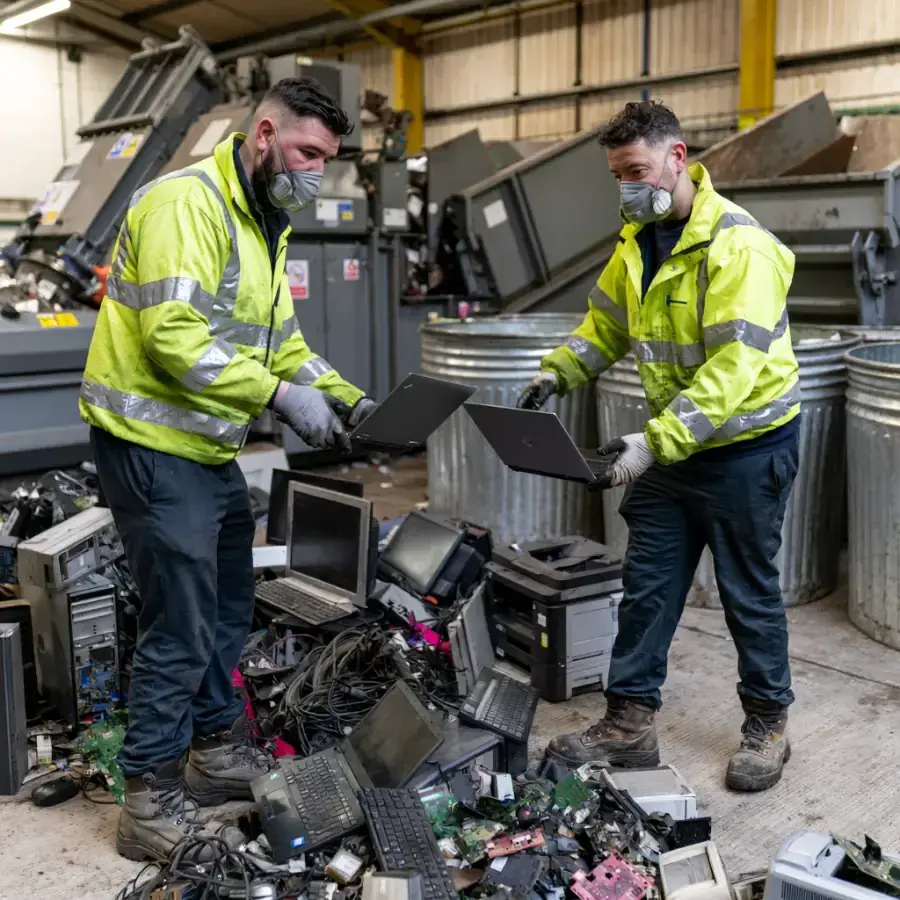
The test is simple: if it has a plug, a battery or a charging port, it is waste electrical and electronic equipment. That covers the obvious — fridges, washing machines, televisions, computers — and the less obvious: power tools, electric toothbrushes, children's toys with a battery compartment, vapes and cables.
WEEE is a regulated stream with recovery obligations attached, and general waste is not a legal route for it. The reason is both value and hazard: it contains recoverable metals worth recovering, and components that must not be crushed or landfilled.
The scale is worth noting. E-waste is the fastest growing waste stream globally, and a great deal of what is in it — copper, aluminium, steel, and small quantities of precious metals — is genuinely valuable if it reaches the right facility.
- Anything with a plug or a battery
- Anything with a charging port
- Large appliances and small
- Screens, IT and telecoms
- Tools, toys and vapes
- Not general waste, ever
Where it goes in Glasgow
Glasgow's four recycling centres — Dawsholm, Polmadie, Easter Queenslie and Shieldhall — all have WEEE points and take household electricals free from residents with proof of address. That is the simplest route for a box of small items.
Retailers have take-back obligations. Anyone selling you a replacement must take the old equivalent item, and larger stores generally accept small items like cables and chargers regardless of where you bought them. Supermarkets and phone shops often have collection bins near the entrance.
The usual constraints apply at the tips: proof of address, resident van time windows, no vans at Polmadie, Easter Queenslie part-closed through 2026. Our Glasgow recycling centres guide has the detail.
More tech than a car boot holds?
Collected under WEEE rules with the metal, including cable copper, properly recovered.
Wipe it before it leaves
Anything that stored data should be dealt with before it goes anywhere. Computers, laptops, phones, tablets, external drives, and — the one people forget — printers and photocopiers, which retain images of what has been scanned or printed.
Deleting files and emptying the bin does not remove the data, and neither does a quick format. Sign out of accounts, deauthorise the device, then perform a full factory reset with encryption enabled, or physically destroy the drive.
For a business this is a UK GDPR obligation rather than good practice, and it needs certified erasure or destruction with documentation — our confidential waste guide covers the requirement, and our old laptop guide covers the domestic version.
Batteries: the fire problem
Lithium-ion cells are the single biggest hazard in the waste stream right now. Crushed in a bin lorry or a sorting facility they ignite, and those fires are frequent and serious enough that waste operators treat them as a leading cause of vehicle and plant fires.
Remove batteries where they come out and take them to a battery collection point — every supermarket has one. Where they are sealed in, as with vapes, power banks and many small devices, the whole item must go through WEEE rather than any bin.
Vapes are the current worst offender: disposable, containing a lithium cell, and binned in enormous numbers. Many recycling centres now take them specifically, and retailers selling them are required to accept them back.
When it's more than a box
An office refit, a school refresh, a business closing or a house clearance produces e-waste at a scale where car journeys stop making sense. Old monitors, printers, servers, phone systems, kitchen appliances and the accumulated cable of years.
We collect WEEE across Scotland under our SEPA carrier registration (WCR/R/3002381) with a duty of care (your legal responsibility for waste you produce) transfer note, and the metal content — including copper from cabling — goes into recovery rather than a mixed load.
For commercial jobs we work out of hours as standard, because a lost trading day costs more than the collection. See WEEE disposal and office clearance.
